Latest News
TEACHING HALAKHAH CONFERENCE A SMASHING SUCCESS! THE SUMMER BEIT MIDRASH CONCLUDES AT YI SHARON Many thanks to Rabbi Dr. Meir Sendor, Rabbi Dovid Reisman, and our host families and the entire shul for your wonderful hospitality. Stanley Weinbaum and Avram Davidson have been best friends since their childhood in the late 50s, when both attended Maimonides School in Boston. Both were products of nominally Orthodox homes but not fully observant homes - their parents kept a kosher home but kept kashrut minimally outside the home and drove on Shabbat, and their mothers never went to mikvah. Stanley went through semikhah and is now the Orthodox rabbi of a small Connecticut community, which he has served for many years. Avram went to Vietnam, married and divorced a non-Jewish woman, and is living in a condo in Berkeley, where he occasionally attends services at Orthodox synagogues but also hangs around at a Buddhist temple. When Stanley visits Berkeley, as he does every few years, Avram is careful to feed him only packaged food with hekhsherim, or they eat in restaurants. The two speak regularly and their friendship and mutual respect have only deepened over the years. One day, a young Conservative woman named Sima Kornbluth comes to Rabbi Weinbaum with a wild story. She is engaged to a secular Israeli named Fred Pohl, and the rabbanut assigned a Rabbi X to their file. On Rabbi X’s insistence she asked her mother, whom she knew to be a convert, for her conversion certificate. Her mother responded that she has no certificate – her conversion took place in a rush somewhere near a military base in the deep South in 1966. Rabbi X immediately tells her that she has no choice but to become fully Orthodox and convert if she wishes to marry Fred, who would have to become observant himself for the conversion to be approved. Sima feels that she cannot commit honestly to Orthodox observance, and asks Rabbi Weinbaum if there is any way she can still marry her fiancé under Orthodox auspices. She is open that they will almost certainly marry in any case, either civilly or in a non-Orthodox ceremony. Rabbi Weinbaum interviews the mother – Sima’s father is no longer alive - and discovers that she is and has been actively Jewish, although never shomeret Shabbat, and that she has sent all her children to Orthodox day schools, and all the children have grown up to keep Shabbat and kashrut to a significant degree. She cannot remember the name of the rabbi who performed the conversion and subsequent wedding, although she was sure that he was Orthodox, and the signatures on her ketubah are illegible. She does remember affirming to three men, including the rabbi, that she accepted all the obligations of Judaism, and then going to the mikvah. She also remembers the name of the Army private who drove her to the conversion – Avram Davidson. Rabbi Weinbaum calls Avram, who confirms the story but also cannot remember the name of the rabbi. He is positive, however, that the rabbi was Orthodox, and that the other two men present each affirmed to the rabbi that they were themselves shomer Shabbat and knew the other to be as well. Rabbi Weinbaum calls you, as head of the local Beit Din, to ask if he can confirm the young woman’s Jewishness and perform the marriage. He states that on the basis of a lifelong friendship he is convinced that Avram would not lie about such a matter. He would like a written response, either so that he will have an adequate defense if attacked for performing the wedding, or to salve his conscience by showing that everything had been tried if in the end he can’t perform the wedding. You should take into account the possibilities that he may choose to show the teshuvah to Sima, Fred, or Rabbi X.
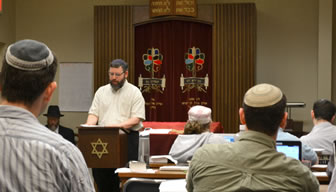
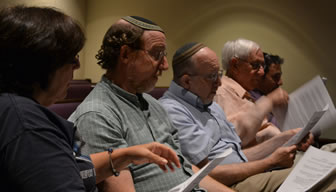
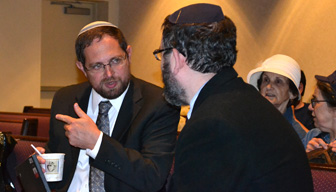
27 rabbis and educators met August 13-14 at Gann Academy in Waltham for four intense, challenging, and exhilarating three-hour sessions. Topics included the relationship of Tanakh to Halakhah, the role of taamei hamitzvot (rationales for Biblical commandments) in religious life, ways of categorizing Halakhah, and whether character improvement is an expected outcome of halakhic education. Participants included faculty and administration from day schools, high schools, and post-high school yeshivot and rabbinical seminaries, as well as JLI campus fellows, synagogue rabbis, and professors. Audio of the sessions will be available soon, and look for a written summary of the proceedings!
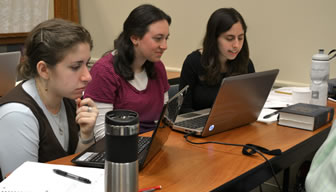
As the capstone of their summer studying “Deciding Halakhah for a Non-Halakhic Constituency: The Case of Credibility”, Summer Beit Midrash Fellows Rob Golder, Lena Hourwitz, Rachel Katler, Yael Klausner, Sarah Nemzer, and Yair Rosenberg have completed writing their teshuvot (Jewish legal responsa) to the following fact-pattern, and critiquing each other’s and Rabbi Klapper’s approaches. Check back for posting of the completed teshuvot, and meanwhile, please share your thoughts about the case!


